
Financial literacy is not enough for financial inclusion
Financial inclusion depends on what people know and the opportunities available to them. Clear information is part of the provider’s responsibility.
Financial literacy is often presented as empowerment. However, it can also transfer responsibility to consumers when institutions leave avoidable complexity or harmful practices unaddressed. Understanding a fee does not make it affordable, and knowing how a product works does not make it suitable.
Financial education therefore needs to sit alongside institutional responsibility for the conditions in which people make decisions. For communications professionals, that means examining whether information helps people use services and where the product itself needs attention.
Consumer knowledge does not equal empowerment
There are many ways that more information does not enable a customer to make an informed decision or take an appropriate action.
Sometimes, it’s about timing. For example, a consumer may understand interest but receive essential information too late to compare credit offers.
At other times, it’s about the broader context. The Consumer Financial Protection Bureau’s research considers the social and economic environment alongside individual knowledge and behaviour. This helps explain why assessments of consumer knowledge also need to examine the conditions in which people are expected to act.
Consumers need broader capability to make financial decisions
Margaret Sherraden’s framework connects the ability to act with the opportunity to act. That opportunity includes access to suitable financial products and services. Improving capability can therefore require changes to the options available to people, alongside support for their knowledge and skills.
A model of what shapes financial wellbeing
Our model brings these influences together. It places knowledge alongside a person’s background, how they think and feel about money, and how choices are presented to them. It then considers the opportunities available, the actions people take and the financial wellbeing they experience.
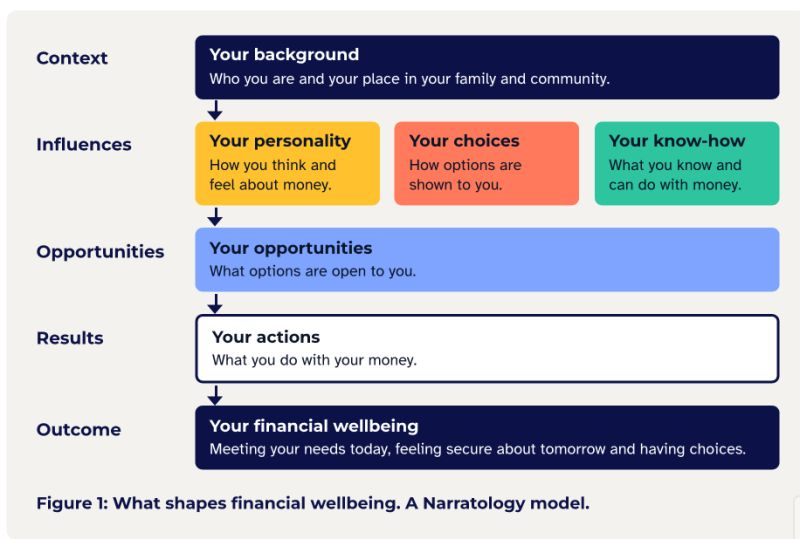
The model makes it easier to see why knowledge alone cannot explain a financial outcome. People also need opportunities to use what they know. Here, financial wellbeing means meeting needs today, feeling secure about tomorrow and having choices.
Inclusion involves more than access
For an inclusion programme, account ownership is a limited measure of progress. Further evidence is needed about how people use the service and whether it meets their needs. This connects the assessment of individual capability with the responsibilities of the provider.
Linking capability with market conduct
The Alliance for Financial Inclusion’s 2026 Consumer Empowerment and Market Conduct Policy Model makes this connection explicit. It addresses consumer capability alongside provider behaviour and supervision. Its six pillars also cover governance, complaints redress and cross-cutting issues, giving institutional responsibility a place in financial inclusion policy.
Communications work can contribute evidence about those responsibilities. A confusing explanation may reveal unclear product terms, while repeated requests for help may expose a difficult process. Rewriting can address a language problem. Changes to eligibility, charges or service access require decisions from the teams responsible for them.
Where does this leave financial education?
Education can improve knowledge and behaviour
Kaiser and colleagues’ meta-analysis found positive average effects of financial education on knowledge and subsequent financial behaviour. This supports education as an intervention with a legitimate purpose. It does not establish that education can replace improvements to unsuitable products or unfair practices.
The programme needs to reflect real decisions
Useful education begins with an understanding of the decisions participants face and the options available to them. Practical skills can then be developed using the information and services they will encounter. A budgeting exercise, for example, needs to account for an irregular income or costs that cannot readily be reduced.
Evaluation also needs to consider what happens after the learning activity. Course completion records participation. It cannot, by itself, show that people can use financial services more effectively or that the services have become more suitable for them.
How plain language can support financial inclusion
The four governing principles in ISO 24495-1 address relevance, findability, understanding and usability. They provide a practical way to examine whether communication works for its intended readers. At Narratology, we connect this review with monitoring and evaluation after publication.
Relevance: information that helps with the decision
For communication to support financial inclusion, it has to address the questions that matter to the people we want to reach. Someone considering an account needs to know whether they qualify and whether they can afford its charges. A detailed description of the account’s features may leave those questions unanswered.
This is why we need to understand the audience before deciding what to include. That research should involve people currently excluded from the service, whose needs may differ from those of existing customers. If it reveals that the account itself is unsuitable, the findings need to inform product decisions as well as changes to the communication.
Findability: information available when it is needed
Information can be relevant and clearly written, yet still be of little help if someone cannot find it. A customer may discover a withdrawal restriction only when trying to access their money, although it would have influenced their original choice. The explanation needs to be easy to find before the decision, as well as when the customer later uses the account.
That means following the customer’s task through the service, from comparing products to accessing funds or making a complaint. When the task moves from a website to a member of staff, the relevant explanation should still be easy to locate. The customer should not have to understand the provider’s internal structure to find the information they need.
Understanding: the practical meaning of the terms
Even when customers can find the right information, they may struggle to work out what it means for them. A term such as “restricted withdrawals” may be familiar to the provider while leaving the customer uncertain about accessing their money. The explanation needs to make clear when they can withdraw money and what any restrictions mean in practice.
The same attention is needed when we present a comparison. If we compare costs, the time periods and conditions need to be clear enough for the comparison to be meaningful. Writing the explanation can also reveal a term whose meaning or fairness needs further review. That is a matter for the responsible team to examine before the communication is finalised.
Usability: testing what people can do with the information
A document can seem clear to the team that wrote it because they already know how the product works. Customers do not necessarily share that knowledge, which is why reviewing the wording within the organisation can only take us so far. We also need to see whether intended readers can use the information.
Testing can involve asking people to work out how to challenge an unexpected charge, using the information they would normally receive. Watching how they approach the task helps us see where they become uncertain and whether the explanation gives them enough help. Including people with different language needs, literacy levels and experience helps us understand whose needs the communication is meeting.
Those findings give us a basis for deciding what to change. Sometimes the difficulty will lie in the wording; sometimes it will involve the service process as well. Testing the revised version then helps us establish whether the change has addressed the problem.
Monitoring and evaluation: the contribution to inclusion
Testing can show whether a revised explanation helps people complete a task. To understand its contribution to financial inclusion, however, we need to look beyond that immediate result. Someone may understand an account’s charges perfectly and still be unable to afford it. Better understanding is useful evidence, but it does not establish that the service meets their needs.
Monitoring after publication helps us see which difficulties continue and who is experiencing them. Complaints or incomplete applications can point us towards a problem, although they do not explain its cause by themselves. Investigating those patterns alongside evidence about affordability and product suitability helps us decide what needs to change and who should act.
Our guide to user testing for financial documents explains how to gather evidence about the communication itself. This provides one part of the evaluation, alongside evidence about whether people can access suitable services and use them to meet their needs.
Sources and further reading
Margaret S. Sherraden. Financial Capability: What Is It, and How Can It Be Created? CSD Working Paper 10-17, 2010. University repository record.
Consumer Financial Protection Bureau. Financial well-being: The goal of financial education. January 2015. Research report.
Alliance for Financial Inclusion. The Consumer Empowerment & Market Conduct Policy Model. 2 September 2026. Policy model.
Tim Kaiser, Annamaria Lusardi, Lukas Menkhoff and Carly Urban. Financial education affects financial knowledge and downstream behaviors. Journal of Financial Economics, 145(2), 2022, pages 255–272. DOI 10.1016/j.jfineco.2021.09.022. Authors' working paper.
International Organization for Standardization. ISO 24495-1:2023, Plain language, Part 1: Governing principles and guidelines. Standard and abstract.
About Frances Gordon
Frances Gordon is Director of Narratology and UK Ambassador for PLAIN. She contributes to plain language standards through the British Standards Institution.
Her work focuses on clear communication in regulated environments, accessibility and financial inclusion. Read Frances's profile.